



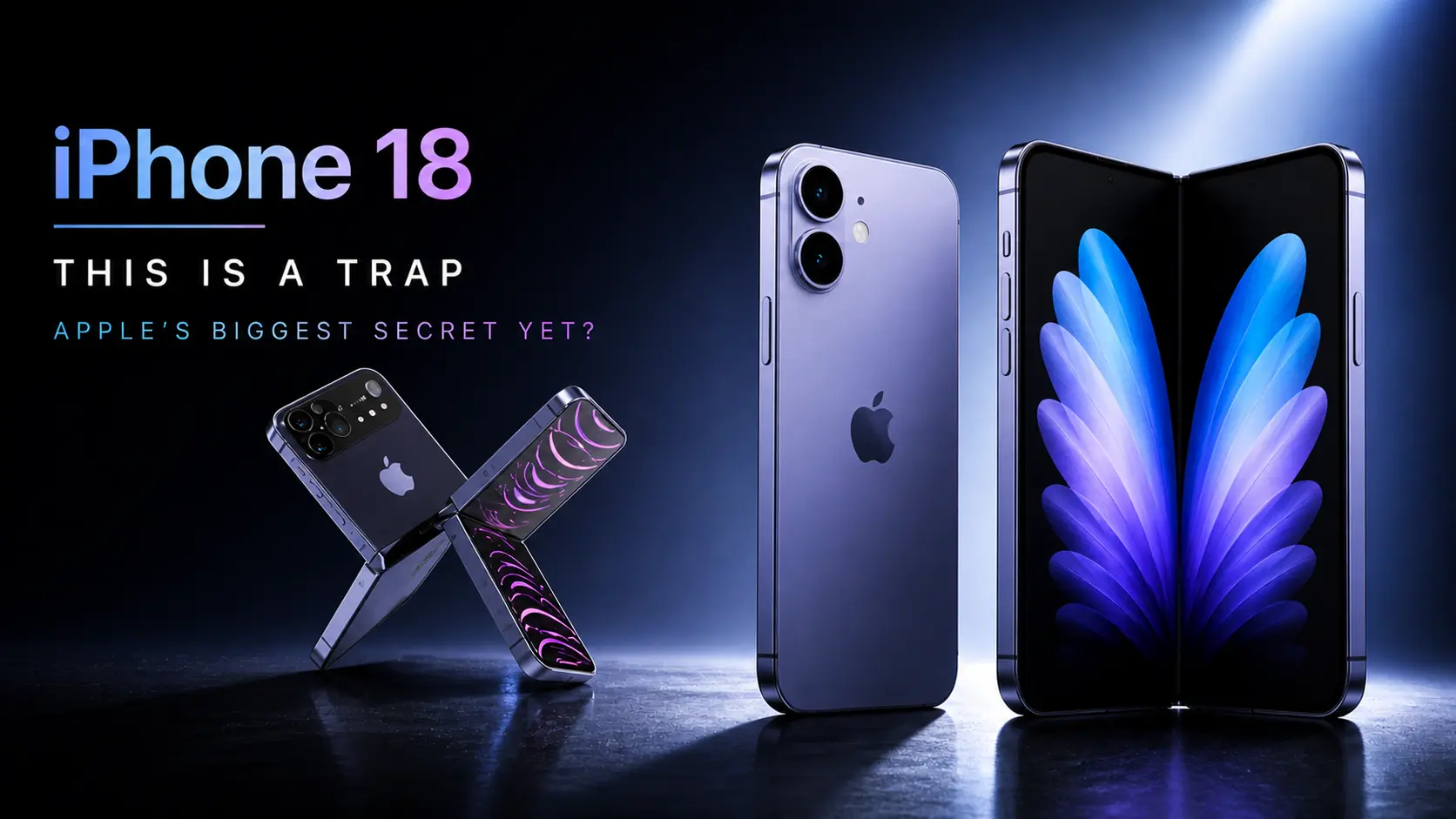
"Most people think the biggest difference between the iPhone 18 Pro and the Fold is the screen. They’re wrong. There Is A Hidden Hardware Trade-Off In The Fold’s Hinge That Apple Hasn’t Solved Yet, And It Might Make You Choose The Pro Instead.”
The biggest news: Apple is splitting its launch iPhone 18 and iPhone Fold.
For the first time, Apple will not release all its new iPhones in September. Bloomberg's Mark Gurman, the most reliable Apple reporter in the industry, confirmed in his a in newsletter that only the premium models will launch in autumn: the iPhone 18 Pro, Pro Max, and the foldable iPhone. Every device at the fall event will cost at least $999. The base iPhone 18, iPhone 18e, and a new iPhone Air won't arrive until spring 2027, per MacRumors' supply chain reporting. If you usually buy a standard iPhone, there is no new iPhone for you this autumn. You'll be waiting until next year.

The foldable iPhone
Bloomberg's Mark Gurman has called this "the most significant overhaul in the iPhone's history." Here's what's been reported.
What it looks like
According to MacRumors' roundup of supply chain sources, the device has two screens: a 5.5-inch outer display for use when folded, and a roughly 7.8-inch inner OLED screen when open. The inner screen uses a 4:3 aspect ratio, the same as an iPad, so it feels more like a small tablet than a stretched phone. Apple chose a book-style design that opens sideways. Unlike the Samsung Galaxy Z Fold, it's wider than it is tall when open. The biggest problem with rival foldables has always been the visible crease where the screen bends. Apple reportedly made eliminating it a non-negotiable priority. Samsung Display has signed a three-year exclusive deal to supply the foldable OLED panels, according to TheElec, a Korean display industry publication. Near-crease-less panels were reportedly demonstrated at CES 2026, per Macworld. The trade-offs (important)
No Face ID. The hinge leaves no room for the True Depth camera system. The phone will use Touch ID via a side button instead, according to analyst Ming-Chi Kuo (January 2026 Substack). This will be the first iPhone without Face ID since the iPhone SE 3rd gen in 2022.
Only two cameras. A 48MP main and an ultrawide, no telephoto. Three lenses simply won't fit in the thin folding chassis, per MacRumors.
Price: Gurman has reported it will "cross the $2,000 threshold." Supply chain estimates put the 256GB starting price between $2,000 and $2,349, roughly $800–$1,150 more than the iPhone 18 Pro. Will it ship in September? In April 2026, Nikkei Asia reported engineering problems could push the launch to 2027. Bloomberg's Gurman rebutted this directly the same day, citing people with knowledge of Apple's plans, calling the report "off base." He confirmed the foldable is on track for September, though added that "timing isn't final" since mass production hasn't fully ramped up. DigiTimes reported mass production shifted from June to August, a delay, but one that still allows a September announcement. Expect limited stock at launch.
Will it ship in September?
In April 2026, Nikkei Asia reported engineering problems could push the launch to 2027. Bloomberg's Gurman rebutted this directly the same day, citing people with knowledge of Apple's plans, calling the report "off base." He confirmed the foldable is on track for September, though added that "timing isn't final" since mass production hasn't fully ramped up. DigiTimes reported mass production shifted from June to August, a delay, but one that still allows a September announcement. Expect limited stock at launch.

iPhone 18 Pro upgrades
New chip: A20
All iPhone 18 models will use Apple's A20 chip, built on TSMC's 2-nanometer process a step down from the 3nm A19. Pro models get the A20 Pro variant.
In plain terms: smaller transistors mean more performance per watt. MacRumors and Macworld cite industry projections of roughly 15% faster performance and 25–30% better power efficiency versus the A19. The efficiency gain matters more in daily use: longer battery life, less heat during video recording, and more headroom for Apple Intelligence features.
Variable-aperture camera
This is the Pro's headline upgrade, and it's unusually well-sourced. Ming-Chi Kuo first reported it in December 2024. MacRumors confirmed in April 2026 that Chinese supplier Sunny Optical has started manufacturing the mechanical actuators and that LG Innotek is installing dedicated equipment at its South Korea factory ahead of module assembly in June or July.
Parts are being made.
That's the strongest prelaunch evidence a feature is real. What it means: every iPhone from the 14 Pro to the 17 Pro has used a fixed lens opening. Variable aperture physically adjusts how much light enters: wider in the dark, narrower in bright sun. It's a hardware change, not a software filter, giving real control over depth of field for the first time on an iPhone.
Smaller Dynamic Island:
Gurman has reported the pill-shaped cutout at the top of the screen will shrink. Some Face ID sensors are moving under the display, reducing the visible notch. Display analyst Ross Young of DSCC and leakers Instant Digital and Shrimp Apple Pro have all corroborated this.
No price increase expected
Despite the new chip and camera hardware, analyst Ming Chi Kuo says Apple will absorb the added costs rather than raise prices. The iPhone 18 Pro is expected to stay at $1,099 and the Pro Max at $1,199.
Source: Talk Tech News (YouTube) — possible preview of the iPhone 18 model.
Note: Apple has not officially announced any of this. Everything below comes from named journalists, analysts, and supply chain sources, not Apple itself.
This article will be updated after Apple's September 2026 announcement
FAQ
Sources
Mark Gurman, Bloomberg (March & April 2026) · Ming-Chi Kuo, Substack (Dec 2024, Jan 2026) · MacRumors iPhone Fold & iPhone 18 Pro roundups (April 2026) · TheElec · DigiTimes · Macworld · Ross Young, DSCC