The End of Apps? Why AI Agents Are the New Interface
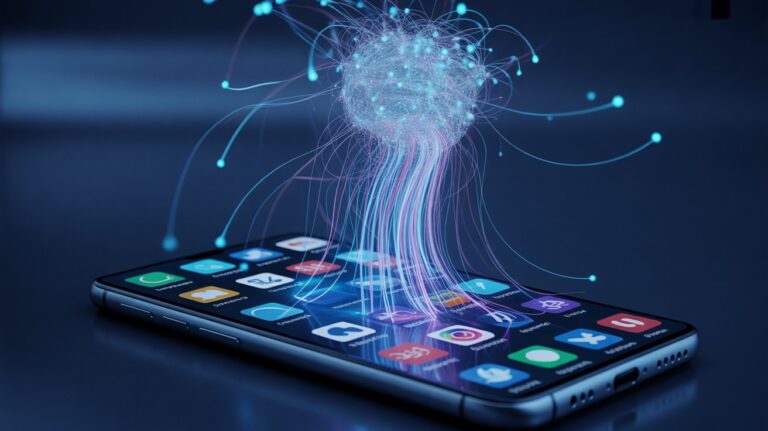
Apps shaped the last 15 years of tech. AI agents are quietly replacing them.
The End of Apps? Why AI Agents Are the New Interface
Introduction: The App Era Is Quietly Ending
Think about the last ten things you did on your phone. You probably opened an app for each one a weather app, a maps app, a banking app, a food delivery app. That is what the last fifteen years of modern tech looked like. One task, one app, one interface to learn.Now imagine instead that you simply say, "Book me a table near the office for two tonight and add it to my calendar." And it happens. No app opened. No menu navigated. No form filled out. An AI agent handled it from end to end.This is not science fiction. It is the next wave of the human revolution in computing, and it is already underway. The question is not whether AI agents will change the way we use technology. The question is how fast and whether you are ready for it.
Context and Background: How We Got Here
Apps were a brilliant solution to a real problem. Before the smartphone era, software was clunky, desktop-bound, and hard to access. Mobile apps gave us lightweight, purpose-built tools that fit in our pockets. They defined a generation of modern tech.But apps were always a compromise. Every app is a separate world with its own login, its own learning curve, its own data silo. The average person uses around 10 apps daily but has dozens more sitting unused on their device. The interface became the friction.AI has been building in the background for years, and 2025 marked a turning point. Large language models became capable enough to reason, plan, and act. Suddenly, the goal shifted from "what app do I open?" to "what outcome do I want?" That shift is the foundation of everything happening in the future of AI right now.
40%
of enterprise apps will have AI agents by end of 2026 — Gartner
82%
of organisations plan to integrate AI agents by 2026 — Capgemini
$52B
projected AI agent market size by 2030, up from $7.8B today
88%
of organisations now use AI in some form — Stanford AI Index 2026

For the first time in computing history, the machine adapts to you, not the other way around.

Breaking free from digital overload: The overwhelming energy of modern applications bursting from a shattered screen.
Main Concept: What Is an AI Agent and How Is It Different?
An AI agent is not a chatbot. A chatbot answers a question and stops. An AI agent understands a goal, breaks it into steps, takes actions across multiple tools and services, checks its own progress, and delivers an outcome often without you doing anything else after the initial request. Think of the difference this way. A chatbot is like asking someone a question. An AI agent is like hiring an assistant who books your travel, confirms your meetings, notifies the hotel, and updates your expenses all because you said "sort out my trip to Delhi next week."
The key traits of an AI agent
An AI agent has three defining characteristics that separate it from older forms of AI. It can perceive context across multiple inputs. It can plan and adapt rather than follow a fixed script. And it can act, calling APIs, filling forms, sending messages, and coordinating with other agents or systems on your behalf. Gartner notes that the most common mistake right now is calling AI assistants "agents" when they are not. The technical term for this is 'agentwashing'. A true agent operates with meaningful autonomy. An assistant still waits for your next instruction at every step.
"The era of simple prompts is over. We are witnessing the agent leap — where AI orchestrates complex, end-to-end workflows semi-autonomously." — Google Cloud, 2026
Real-World Impact: How This Affects Users, Businesses, and Developers
For everyday users
The most direct impact of AI agents on users is the removal of interface fatigue. You stop managing tools and start stating goals. A single AI layer sits between you and every service you use, translating your intent into action. This is what the future of AI looks like for the average person: not more features to learn, but fewer steps to take. AI agents are already handling up to 60% of all customer service interactions in several industries. They are booking appointments; answering complex health questions Microsoft's Copilot and Bing answer more than 50 million health queries daily and managing shopping experiences that adapt in real time to your behaviour.
For businesses
For companies, the implications of modern tech shifting toward agents are enormous. The traditional software stack, CRM, ERP, email, calendar, and project management, all separate, becomes a layer that agents sit on top of and coordinate. Rather than employees switching between tools, agents read data, trigger workflows, and surface insights across systems automatically. Salesforce research shows a 282% jump in AI adoption among businesses in recent periods. Organisations using AI agents in sales are seeing them qualify leads, book meetings, and follow up with prospects continuously behaving more like junior team members than static automation scripts.
For developers
The shift to agents is also fundamentally changing what it means to build software. Low-code and no-code agent platforms mean that teams can now deploy working agents in 15 to 60 minutes without deep engineering knowledge. Business users, not just developers, are building agents. This democratisation of AI is accelerating the pace of modern tech innovation faster than most people realise.
Practical Insights: How to Adapt and Benefit Right Start by identifying repetitive decision chains
AI agents deliver the most value when they replace predictable, multi-step workflows. Look at the things your team does repeatedly qualify a lead, process a support ticket, and schedule and confirm a meeting. Those are the first places to deploy agents.
Think in outcomes, not features
The mental model shift required for the future of AI is significant. Instead of asking, "Which app handles this task?" you need to ask, "What outcome do I need, and what data and actions are required to reach it?" Agents are goal-driven, so the clearer your goal, the better they perform.
Build skills around AI direction, not just AI use
As AI takes on more execution work, human value shifts to goal-setting, validation, and judgement. Prompt engineering, the ability to instruct AI agents clearly and precisely, is already one of the most in-demand skills in modern tech hiring. Investing in this capability now is one of the smartest moves any professional can make.
Prioritise governance before scale
IBM Research and multiple industry analysts agree on this point: organisations that build governance frameworks before scaling agents are the ones that succeed. Every agent should have a defined identity, limited access scope, and clear accountability. Security is not an afterthought in the age of agents. As Microsoft's VP of Security notes, every agent should have security protections equivalent to those applied to human employees.
Expert Perspective: The Shift Is Not About Technology; It Is About Interface Philosophy
Here is a view that most coverage misses. The move from apps to AI agents is not primarily a technical revolution. It is a philosophical one. For decades, we have designed technology around what computers can do well structured menus, buttons, forms, and icon grids. We made humans adapt to machine logic. AI agents invert this completely. For the first time, technology adapts to human intent. You do not open an interface. You express a need. The system figures out the rest. This is the human revolution in its truest sense not humans being replaced by machines, but machines finally learning to serve human thought patterns rather than the other way around. IBM's VP of Quantum and AI describes the coming shift as software moving from informal interactions to structured goal validation protocols, where users define what success looks like and agents autonomously work toward it. That is a fundamental redesign of the human-computer relationship that has existed since the first personal computer. The companies and individuals who understand this shift and reorient themselves around it will have a structural advantage in every industry. Those who keep treating AI as a feature bolted onto existing app-centric workflows will find themselves managing increasingly obsolete complexity.
Best Practices and Recommendations Do not abandon apps overnight
Apps and agents will coexist for years. The transition is gradual. The smart move is to layer agent capabilities on top of existing tools rather than replacing them outright. Most modern platforms Salesforce, HubSpot, and Microsoft 365 already support agent integration. Use this as your entry point.
Design for agent readability, not just human usability
If you build digital products, this is critical. Agents interact with your interfaces through APIs, webhooks, and structured data. A product that is not agent-accessible will be increasingly invisible in the future of the AI ecosystem. Clean APIs and structured outputs are now as important as good UX design.
Embrace blended teams
By 2028, research suggests 38% of organisations will have AI agents functioning as formal team members within human groups. This is not a future problem to plan for later. Teams that start building workflows assuming AI participation now will adapt far more naturally than those that bolt agents on after the fact.
Measure outcomes, not activities
Traditional productivity metrics count actions: emails sent, tickets closed, calls made. In an agent-driven environment, these numbers lose meaning because agents can inflate all of them. What matters is outcome quality. Did the lead convert? Did the customer resolve their problem? Did the project ship on time? Shift your measurement frameworks accordingly.
Conclusion: The Interface Is Disappearing, and That Is the Point
The greatest interfaces are the ones you stop noticing. The keyboard, the touchscreen, and voice assistants each one reduced friction until it felt invisible. AI agents are the next step in that progression, and they are by far the most radical one yet. The end of apps is not a loss. It is a graduation. We are moving from a world of tools we manage to a world of agents that manage things for us. The app-era question was "How do I use this?" The agent-era question is simply, "What do I want?" For users, this means more time on high-value thinking and less time on interface navigation. For businesses, it means AI that does not just assist but participates. For the broader human revolution in technology, it means we are finally building systems that think the way people do. The shift is real, it is measurable, and it is accelerating. The only question left is where you choose to stand as it unfolds.